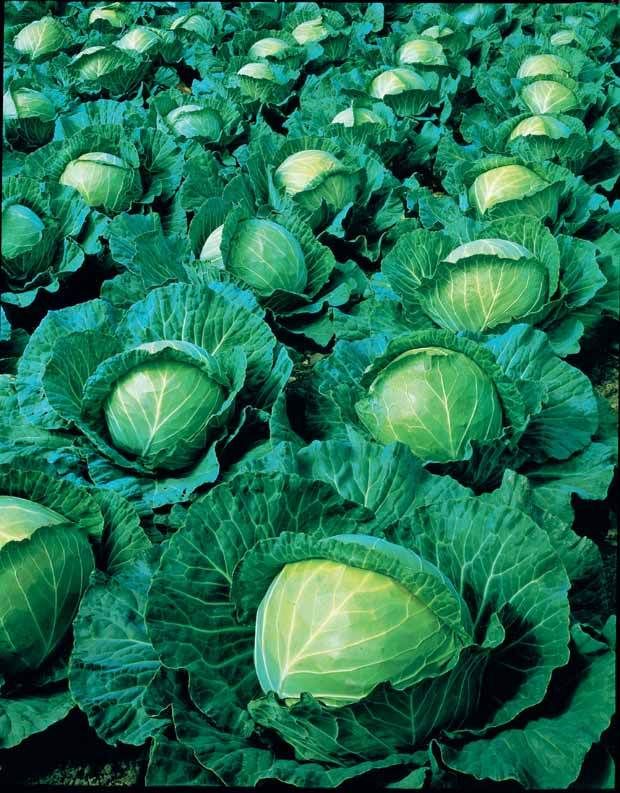
Variety selection
Many cabbage varieties are available in the Kenyan market, and they differ in terms of size, shape, maturity date, adaptability and disease resistance.
Types of cabbage varieties
Red cabbage
Savoy Type
Gloria F1
Copenhagen
Amigo F1
Pruktor F1
Baraka F1
Blue dynasty F1
Factors to consider when selecting a cabbage variety:
Expected yield output per unit area of production.
Disease tolerance/resistance.
Buyer preference and market acceptability.
Unique characteristics such as color, growth habits and shape.
Adaptability to the growing area.
For new varieties in the market, farmers should try a small piece of planting first before adapting it in their production system. Production levels may vary from season to season depending on the environmental conditions. Good varieties are adaptable over a wide range of conditions.
Seedling production in seedbeds.
Tips for seedling production:
Seed requirements: 200 to 250g of certified seeds per hectare of production.
It's best to avoid establishing a nursery in an area where cabbage has been previously cultivated, as this can increase the risk of soil-borne diseases and pests that specifically target cabbage crops.
Always use certified seeds with the desired attributes.
Always grow seeds in well-aerated media (peat, bark and vermiculite), with good water holding capacity and at a pH of around 6.5.
The media should be pre-enriched and the seedlings should be fertilized.
The ideal temperature for seedling cultivation is 20°C.
The seedling trays should be placed in germination chambers with temperatures of about 20°C for optimum germination.
Always be keen on avoiding poor drainage and build-up of mould in the media, as these can significantly affect the health of the seedlings. Poor drainage can lead to waterlogging, which may result in root rot and other diseases, ultimately weakening the seedlings. Ensure that the seedling trays or seedbeds are well-drained, allowing excess water to flow out freely.
To prevent mold buildup, regularly monitor the humidity levels and avoid over-watering. Proper aeration of the seedling area is crucial, as stagnant air encourages fungal growth. If mold is detected, remove the affected seedlings and apply appropriate fungicidal treatments to prevent further spread. Maintaining clean and sterile seedling trays and tools can also help in controlling fungal infections during the seedling production phase.
Seedling management is a crucial factor in cabbage production. The following factors related to seedling production may result into disorders in the life of the crop:
• Incorrect sowing time.
• Cold temperatures, particularly below 7 °C.
• Cold grown seedlings.
• Over-fertilization of seedlings.
• Oversized seedlings at transplant.
• Temperature differences between the seedling nursery and the farm.
• Outbreak of the pest and diseases
Seedbed preparation procedure
Seedbed is prepared approximately 5 - 15 cm high and 1.0 m wide.
Step 1: Apply a thin layer of compost on the seedbed before mulching (with rice straw).
Step 2: In a square meter seedbed, incorporate 40 g ammonium sulfate, 50 g super phosphate, 30 g potassium chloride, and 2 kg compost manure. Commercial inorganic fertilizer could be skipped for organic farming.
Step 3: Protect the seedbed with a net or shed to prevent the seedlings from early pest infestation, heavy rain, and direct sunlight.
Step 4: In the seedbed, sow 15 -20 seeds per 30 cm (1 foot) at a depth of 0.5–1.0 cm or in seed trays (grown under greenhouse), sow 2–3 seeds per hole at a depth of 0.5–1.0 cm.
It is important to note that;
Optimum temperature requirement for germination is 20 –25°C. The seeds germinate after 3–5 days.
Practice thinning during the first leaf stage (removing overcrowded or unhealthy seedlings, allowing the remaining healthy plants to develop without competition) during the first leaf stage.
Always practice the hardening activity - The activity consists of gradually exposing seedlings daily to strong sunlight and also reducing the water supply to lessen stress and transplant shock of the seedlings after transplanting. This should be done 5 days before transplanting.
Field Preparation and Planting
Plough and harrow the field until the soil is fine, level and free of weeds and plant debris.
Form the bed with a plow by opening furrows to a depth of 20 cm during the dry season or at least 30 cm during the wet season.
Seed required for direct seeding are 600g - 1.5 kg of seeds/ha are needed for direct seeding if the planting distance ranges from 100 - 150cm in between rows and 25 cm - 45 cm in between hills and 3 kg/ha if the distance of planting ranges from 40 - 50 cm in between rows and 25 - 45 in between hills.
The grower should ensure that seedlings are planted at the correct depth in a little hole that has been formed into the ground prior to planting. If the seedlings are forced into the ground, without a hole being prepared for them to be inserted into, the root system will be compromised and the plant will experience stress resulting in poor yield.
Once the seedling is placed inside the hole the area should be firmed so that sufficient contact is made between the seedling and the soil. When planting seedlings, a choice can be made between the square method and the staggered method of planting. The staggered method is more advantageous as there is less competition between plants compared to the square method where plants are directly opposite each other, thus maximizing competition.
Plant Population and Spacing
It is recommended that 26 000 – 30 000 plants/ha are planted for the loose head market. Higher plant populations raise the average yield per hectare, but the heads are smaller. For the bagging or chain-store/pre-pack market a density of 35 000 - 45 000 plants/ ha is recommended.
However, it must be noted that the population of a cabbage field per hectare for a commercial grower can vary and planting is dependent on what the specific market needs and available resources are.
The following guidelines explain the recommended spacing and requirements for the various markets.
Loose head/hawker market
Head size, weight & hold-ability are important features.
Plant density of ± 26 – 30 000 plants/ha.
Plant spacing of 60 - 70cm X 60cm.
Bagging/chain store/pre-pack market
Quality, uniformly filled heads, firmness and color are important.
Yield per hectare and uniform cut.
Plant density of 35 – 45 000 plants / ha.
Plant spacing of 45 – 55cm X 60cm.
For baby cabbage, varieties have a smaller head size and the population can be increased. A plant spacing of 25cm (in row) X 25 cm can be used as a guideline.
Fertilization
Cabbage needs plenty of nutrients.
NPK is needed for head formation. However, excess nitrogen (N) may cause loose head formation and internal decay. Potassium (K) deficiency can result in marginal necrosis and lower head quality, but its excess can cause the heads to open. The plants have high Sulfur requirement; sensitive to deficiencies of Calcium, Magnesium, and Boron.
The general fertilizer recommendation: 100 - 150 kg/ha N: 50 - 65 kg/ha P: 100 - 130 kg/ha K.
Split the recommended fertilizer amount into 3 and apply it as basal, 3 weeks after transplanting, and during heading.
During land preparation, incorporate 10-20 tons of manure/ha.
These are just general recommendations. Proper adjustments should be made according to your local soil conditions. To be sure, soil analysis is highly recommended to determine nitro-gen, phosphorus, and potassium requirements of your soil.
Commercial inorganic fertilizer could be skipped for organic farming.
Cabbage Water Requirement
Cabbage needs a sufficient amount, although young cabbage transplants or seedlings have a lower water requirement. However, water requirement increases rapidly as complete canopy cover and head development occurs.
Water daily until the plants establish fully. Always water the plants when wilting happens. However, the plants are very sensitive to flooding. During the rainy season, appropriate drainage canals must be in place to drain off the excess water after a heavy rain. Irrigation must be closely monitored to ensure soil moisture remains even in the beds during the cropping period. It is particularly important in the days following transplanting when seedlings are establishing new root systems. Excessive irrigation promotes root rot and results in leaching of nutrients away from the root zone. Supplying water in equal amounts throughout the season prevents cracking of the heads. Application of soluble fertilizers as fertigation can be carried out during a normal irrigation.
Total water requirement is approximately 440mm. In wet seasons, as a general guideline apply 10 to 15 mm per week for the first third to half of the growing season, and about 25 mm per week thereafter.
On hot days, apply 20 to 25 mm per week for the first third to half of the growing season and 40 to 50 mm per week thereafter.