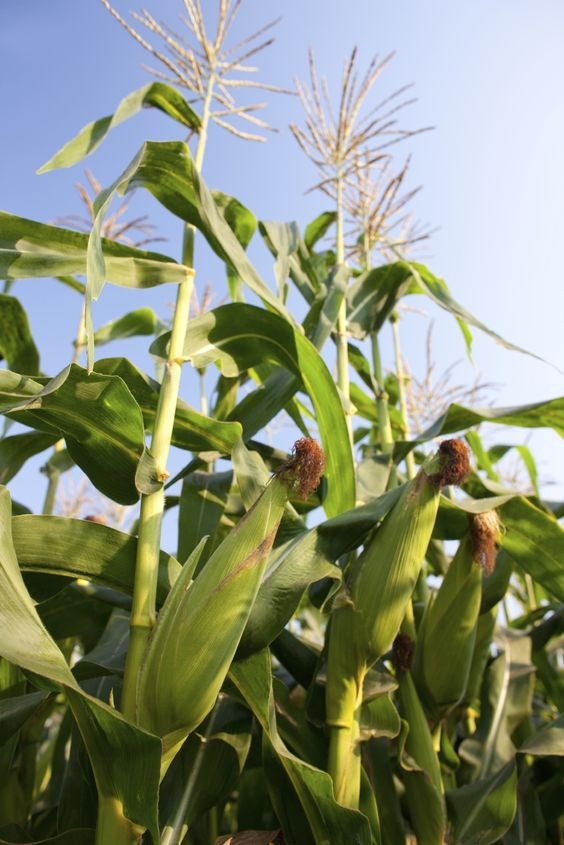
Maize is a cornerstone of agriculture in Kenya, predominantly cultivated by smallholder farmers. It serves as a crucial source of livelihood for many and significantly contributes to the country's economic growth. Despite its importance, maize yields are experiencing a marked decline, largely due to the impacts of climate change.
The optimal growth of maize requires warm temperatures, moderate rainfall, and fertile, light loamy, well-drained soils. Given the current environmental pressures, it is imperative for smallholder farmers and agricultural extension services to embrace and implement sustainable farming practices. These practices are essential for reversing yield declines, improving resilience to climate change, and ensuring long-term agricultural sustainability.
Different stages of maize production
Seedling stage of maize - This is the initial phase after planting, where the maize seeds germinate and seedlings emerge. It starts a few days after planting and lasts up to two weeks.
Ensure adequate water at this initial stage.
Growth Stage of Maize - Major growth occurs here, there is rapid growth in plant height as the maize produces additional leaves and a root system to access water and nutrients. It takes approximately 30 to 45 days after planting.
Ensure consistent irrigation to support vigorous growth. Dressing, weeding are done during this stage.
Tasseling Stage of Maize - characterized with the formation of the tassel, the male part of the plant, which produces pollen. It occurs around 50 to 70 days after planting.
Ensure consistent water supply at this stage as water insufficiency during this stage can significantly reduce yield.
Silking Stage of Maize - Characterized with maize ears production and silks emerge from the husks.
Ensure consistent water supply as water insufficiency can disrupt kernel development. Monitor pests and diseases.
Milking stage of maize - The maize kernels enter the "milk" stage, indicating that the kernels are developing but are not fully mature.
Ensure consistent water supply, as kernels are highly sensitive to drought stress at this stage.
Maize varieties
Overall, there were 389 maize varieties that have been officially released for commercial cultivation in Kenya as at August 2020. Consequently, you can select from numerous maize varieties that have been developed. The selection of a particular variety will depend on the desired characteristics and special attributes. The choice of a particular variety should be based on the priority needs of an individual farmer, taking into consideration the abiotic and biotic factors that are likely to affect production.
Note that a list of maize varieties can be accessed in the producing company profiles/websites.
Seed selection and acquisition
The farmer can use either locally adapted high breed seeds or open pollinated varieties.
Definition of hybrid seeds and Open pollinated seeds
Hybrid seeds are produced from crossing two different parents to produce an offspring with improved characteristics from both parents. For instance, you can cross two OPV lines (parents) to come up with a hybrid containing the desired characteristics from either parent.
In contrast, open pollinated varieties are usually considered true to type because they possess identical genotypic constitution and are thus a complete replica of the original parent. These varieties are produced upon self-pollination of two parents with similar genetic constitution.
The selection of either hybrid or open pollinated varieties is very dynamic and depends on complex factors which eventually affect the farmer’s decision.
Why hybrid seeds?
Selecting hybrid varieties are considered supreme for their superior genetic constitution, better yield output, tolerance to diverse biotic and abiotic factors against which it was developed and uniformity in plant height and maturity.
However, OPV also plays a vital role in production, especially where farmers save seeds for planting in the consequent seasons.
Where should you purchase seeds?
The farmers should always purchase certified seeds from a licensed and trusted vendor every season to increase the yield advantage of both varieties. Whereas a farmer can select a phenotypically superior crop and cob, that is disease and pests free and use them as seed maize the following seasons, a farmer should never do the
same for hybrid maize. The reason being a hybrid seed is an F1 offspring and the
produce acquired from it after pollination is F2 and will not possess
similar properties to the original F1 seeds. On the other hand, a farmer can plant OPV for up to three successive seasons without the need to purchase new seeds. The farmer should always scratch the sticker that accompanies KEPHIS logo or the producing company’s logo to reveal the concealed number. Send the concealed number to the provided code to ascertain the authenticity of the seed before planting to avoid losses that would otherwise result from planting counterfeit seeds.
Germination test
For purposes of confirmation that the seeds are true to type, a farmer can conduct a germination test at least 10 days prior to planting. To determine the germination capacity of your seeds, conduct the following procedure:
Step 1: Randomly select 100 seeds from the seed lot (packet of purchased)
Step 2: Plant in a small section of the field previously prepared for the exercise or plant the seedlings in a container placed outside in the sun and watered appropriately.
Step 3:Take stand count after eight days to determine the vigor of the seeds.
Step 4: Work out the germination percentage.
Germination percentage = Total no. of germinated seeds * 100
Total no. of seeds tested
For instance: A researcher carried out a germinated test. He randomly selected 100 seeds from the purchased packet and planted them in a farm plot under optimal conditions. After 11 days, only 30 seeds had germinated.
G% = 30(No. of germinated seeds) * 100
100 (No.of seeds planted)
G% = 30%
Confirm with the germination percentage indicated on the package to ensure it tallies.
NB: Where the germination percentage is below 85%, consider discarding
the seed lot and purchase another one of higher quality or plant more seeds.
Tips:
Always check for expiry dates and confirm that other attributes such as physical and genetic purity are true to type.
Store the seeds in cool and dry conditions as indicated in the packaging material.
Keep seeds out of reach of children as some seeds contain protectant pesticides and to avoid damage. Rodents and other pests can cause serious damage to your seeds and therefore laying down appropriate management is mandatory.
Keep seeds out of reach of children, as some seeds contain protective pesticides.
To prevent damage from rodents and other pests, it is essential to implement appropriate pest management strategies.