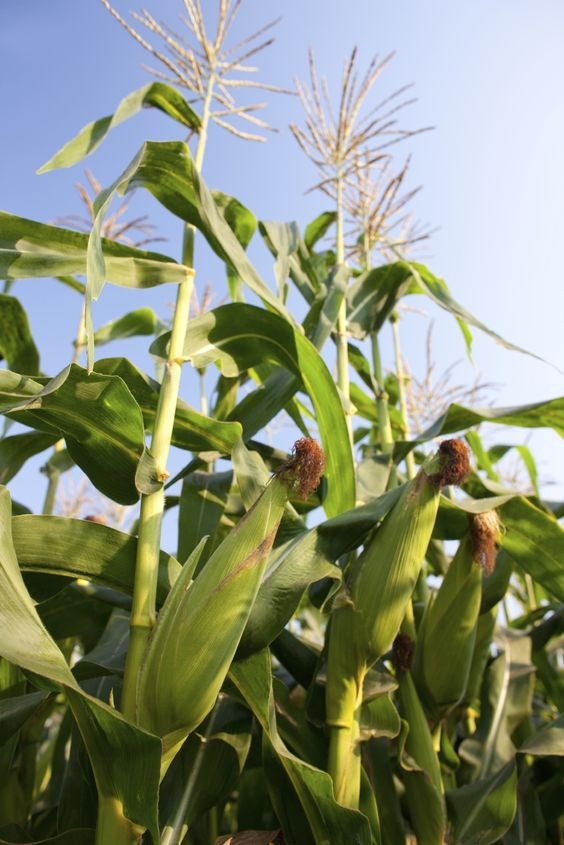
Planting
Planting should be done on the onset of an effective rainfall. Early planting is desirable to enable the crop stands to take advantage of the nitrogen flush that is associated with onset of rains.
However, ensure that the rains have sufficiently established before planting given that the onset of rains have been quite unpredictable.
Early planting also helps you optimize on the use of available moisture throughout the cropping season. Delayed planting of two weeks and above have been associated with lower yield output associated with mid-season drought. Also, the damage caused by pests and disease on late-maturing crops is very severe and usually results in low yield output.
You should only plant on a flat surface when the field is relatively flat and has excellent drainage. Planting on ridges reduces stagnation of water on poorly drained soils thus resulting in better soil aeration, less nutrient leaching with overall positive increase in productivity.
Ensure that you follow the recommended plant spacing for the variety of choice you have selected to plant. The recommendations on spacing are usually included on the packaging container. Since different varieties require different spacing, the recommended plant population should vary from 37, 000 to 53, 333. However, the general recommended spacing for high altitude AEZs is 75*25 cm for one plant per hole on pure stand and 75*50 cm for two plants per hole for intercrops.
As a rule of thumb, consider lower plant population for taller maize varieties and higher population for shorter varieties.
The number of seeds per hole also depends on the results of the germination test. Plant two seeds per hole for seed lots that exhibited higher than 85% germination percentage. Otherwise, plant three seeds per hole for seedlings that exhibited between 70 and 84% germination percentage. Planting depth will vary from 5 to 10 cm depending on the soil type. For heavy soils, consider shallower planting compared to lighter soils such as sandy soils.
Intercropping and rotation
You can intercrop maize with diverse crops including legumes such as beans, peas, groundnuts etc. The most common intercrops are beans and groundnuts. Generally, legume will fix nitrogen into the soil, reducing the crop nitrogen demand in the subsequent cropping seasons. Though the individual yield output is usually lower for each crop when intercropped, the overall land productivity is usually higher, and the farmer reaps better returns per unit piece of land as opposed to planting a single line of crop.
For optimal performance when intercropped with beans or soybeans, the following recommended spacing will yield satisfactory results.
Consider spacing two rows of maize at 90*60cm and two rows of beans in between the
maize rows at 50*20cm.
A single row of maize spaced at 100*25 cm and double rows of beans spaced at 50*10cm.
A single row of maize and three rows of beans, spaced at 120*60cm. For each of the above spacing, consider planting two seeds per hole. Note that the spacing is recommended above will reduce the maize stand count by approximately 10, 20 and 40%, respectively.
You can also plant maize on the farm immediately after harvesting beans or groundnuts. Rotation helps reduce pest and disease build up by breaking their life cycles and nourishes the soil structure and fertility.